

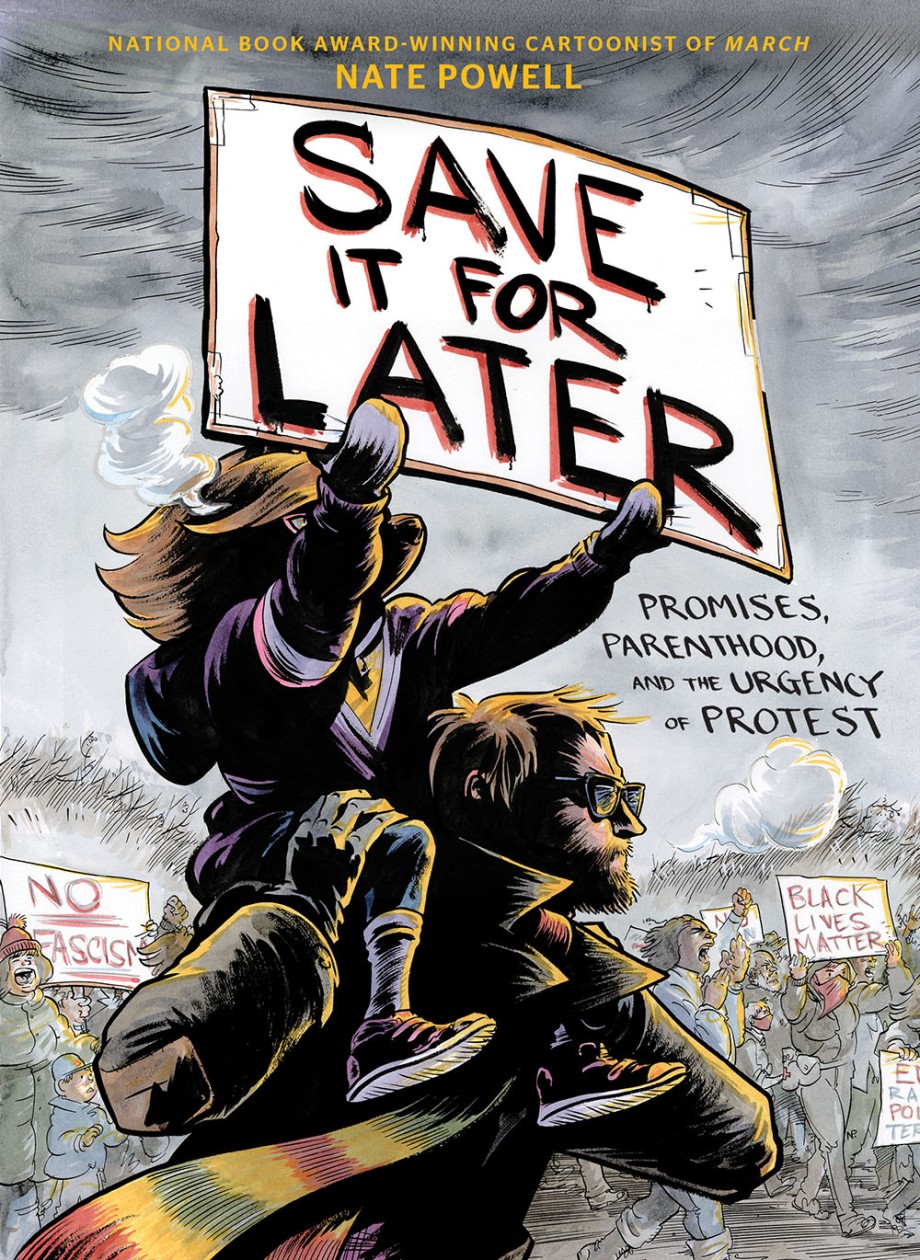
Save It for Later
Nate Powell
Format:
Ebook
Publication Date: April 6, 2021
Available from:
From Nate Powell, the National Book Award–winning artist of March, comes Save It for Later: Promises, Parenthood, and the Urgency of Protest, a deeply resonant collection of graphic nonfiction essays that examines how ordinary people navigate extraordinary political times.
Blending personal narrative, cultural critique, and visual storytelling, Powell chronicles what it has meant to raise young children, create meaningful art, and remain civically engaged during a period defined by polarization, protest movements, and a rapidly shifting public conscience.
Across seven interwoven comics essays, Powell traces the arc from the 2016 presidential election through the social upheavals of the early 2020s. As he witnesses the breakdown of civil discourse while working on the landmark March trilogy, he interrogates the rise of extremist and paramilitary symbolism in everyday American culture and reflects on the responsibility each of us holds within our families, communities, and public spaces.
Powell's storytelling moves fluidly between the intimate and the societal—from the promises he makes to his young daughter on election night, to the lived realities of an increasingly authoritarian political climate, to the challenge of teaching children how to recognize injustice and raise their own voices safely and effectively.
His widely circulated essay "About Face" appears here alongside new and expanded work, culminating in a final piece that contextualizes the defining events of 2020—including the COVID‑19 pandemic, the national and global response to the murder of George Floyd, and the presidential election—within the larger continuum of American protest culture.
Rendered with Powell's signature emotional acuity, the book portrays his daughters as imaginative anthropomorphic characters, illuminating the hope, fear, and resilience that coexist in times of collective uncertainty. As he documents protests, conversations with neighbors, and moments of cross‑community solidarity, Powell reveals both the fragility and the power of social trust—and what it takes to nurture it.
Save It for Later stands as an essential reflection on how families, artists, and engaged citizens continue to confront disinformation, extremism, and cultural fragmentation. It is a vital call to equip the next generation with the tools, context, and courage they need to shape a more just and compassionate future.